
One Source of Truth: Why Most Companies Get It Wrong
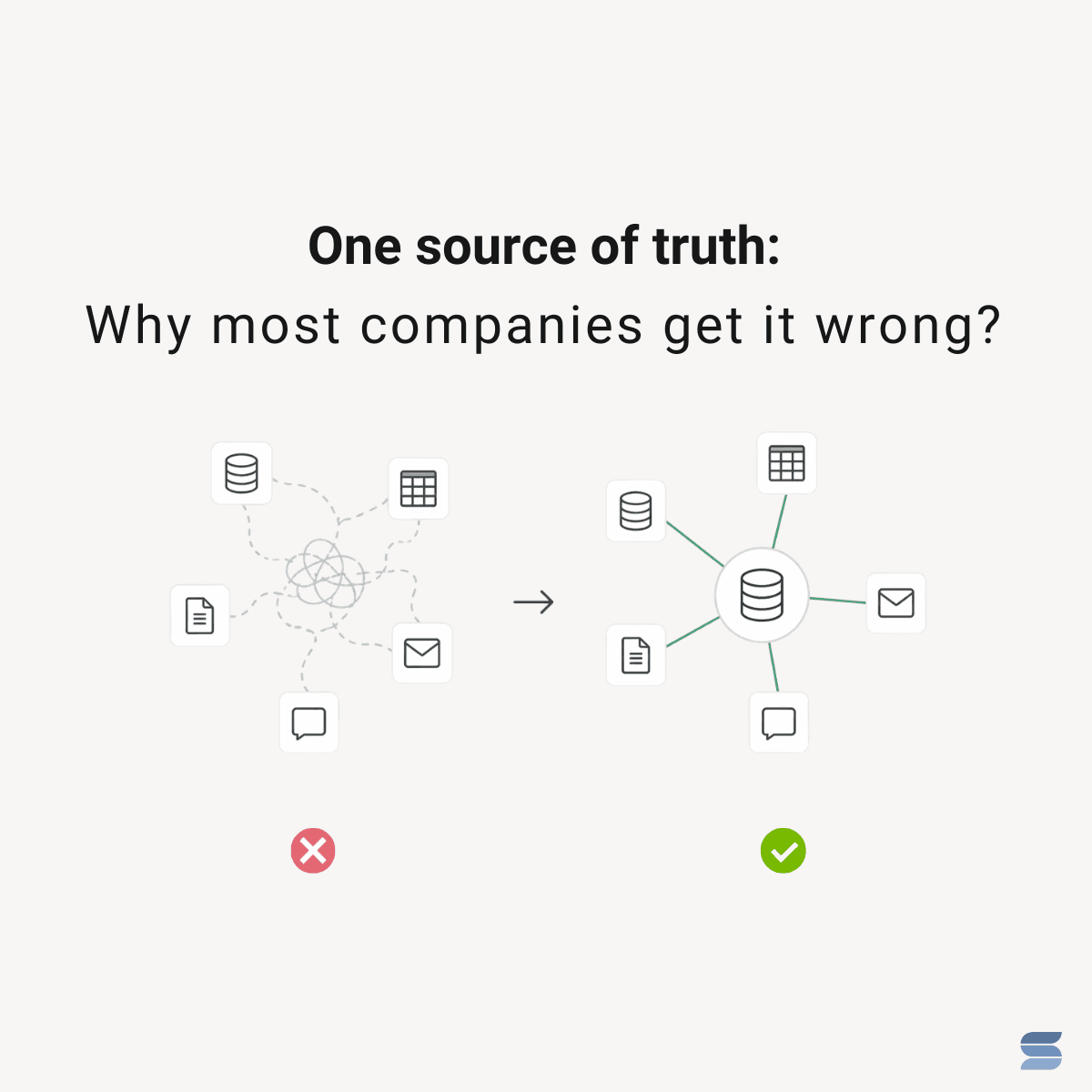
Open any modern company’s tech stack and you’ll see the same thing.
A growing list of tools:
One for product data
One for analytics
One for reporting
One for internal workflows
A few more "just in case"
At some point, adding tools feels like progress.
Until it doesn’t.
The hidden cost of “just one more tool“
Every new tool promises efficiency.
But in reality, it often adds:
Another system to maintain
Another place where data lives
Another integration that can break
Another workflow your team has to learn
What starts as optimization slowly turns into fragmentation.
Processes slow down.
Teams stop trusting the data.
Simple updates become multi-step operations.
And suddenly, your “modern stack“ is working against you.
The real problem isn’t capability. It’s fragmentation.
Most companies don’t lack tools.
They lack systems.
Tools solve individual problems, but systems connect them into a unified whole.
Without that connection:
Product data is inconsistent
Reports don’t match reality
Decisions are delayed
Teams duplicate work
Why fewer tools win
The companies scaling today aren’t the ones with the biggest stacks.
They’re the ones with the cleanest ones.
They focus on:
Centralizing data
Reducing duplication
Automating workflows
Connecting everything that matters
Instead of adding more tools, they build or adopt systems that replace multiple tools at once.
That’s where real efficiency comes from.
What this looks like in practice
One of the most common examples we see is product data.
It lives everywhere:
Spreadsheets
Marketplaces
Internal systems
eCommerce platforms
Different teams update separate systems, leaving no clear source of truth.
A centralized system solves this by allowing you to manage all product data in one place while automatically updating everything else.
No duplication.
No confusion.
No wasted time.
From tools to systems
At SCode, we don’t focus on adding more software into the mix.
We focus on:
Replacing fragmented tools with unified systems
Connecting existing platforms where it makes sense
Building solutions when off-the-shelf tools fall short
The goal is always the same:
Less complexity. More clarity.
The shift that changes everything
When your systems are structured properly:
Teams move faster
Data becomes reliable
Decisions become easier
Growth becomes scalable
Not because you added more tools.
But because you finally removed the unnecessary ones.